
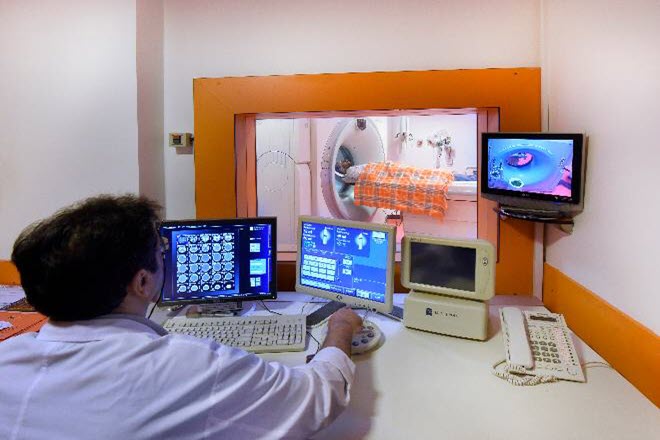
Diagnostic Services and Performance of the Multi-Slice CT Angiography Center at Jam Hospital
The diagnostic services and performance of the Multi-Slice CT Angiography Center at Jam Hospital are ready to serve our respected patients as follows.
The vessels that supply blood to your heart muscle are called coronary arteries. These vessels may become narrowed by a substance called plaque, which consists of cells, fat deposits (cholesterol), and sometimes calcium. This narrowing reduces blood flow. If one of these plaques ruptures and a clot forms on top of it, sudden blockage of the vessel occurs, leading to a heart attack.
Cardiac CT Angiography
Cardiac CT angiography is a new non invasive method that is gradually replacing invasive coronary angiography worldwide. Using this method, within 15 minutes, three dimensional images of your vessels are taken using X rays, and it becomes clear whether your coronary arteries are narrowed or not. If narrowing exists, its exact location and degree are determined.
Center Features
The center is equipped with the latest devices and software from the German company Siemens, which offers the best quality and techniques.
Appointment Scheduling
Appointments are scheduled efficiently. After arriving at the center, patients are guided to receive services at the designated time. Your time is valuable to us, and you will not experience any delays at this center.
All CT scan procedures performed at this center include
Cardiac coronary CT angiography
CT angiography of all body vessels including brain and neck, lungs, abdomen and pelvis, upper and lower limbs
CT scans of all organs with or without contrast injection
Various types of biopsies, fluoroscopy, 3D and 4D imaging
Comparison of Diagnostic Capabilities between CT Angiography and Invasive Angiography
As mentioned, CT angiography can provide you with comprehensive and practical information regarding vessel anatomy, the presence of congenital vascular abnormalities, and the pattern of vessel involvement. Additionally, the presence of congenital and acquired vascular communications such as aneurysms which is abnormal dilation of a vessel, dissection which is a tear in the inner vessel wall, vascular shunts which are abnormal connections between an artery and vein or heart chambers, as well as intracardiac shunts such as ASD which is atrial septal defect, VSD which is ventricular septal defect, and PDA which is patent ductus arteriosus, are all well identified by CT angiography.
Comparison of Diagnostic Capabilities between CT Angiography and Other Non Invasive Cardiac and Vascular Methods
The exercise stress test has a sensitivity of 63 percent and diagnostic accuracy of 74 percent, with approximately 25 percent false positives and false negatives.
Nuclear diagnostic methods such as cardiac thallium scan have a sensitivity of 85 percent and specificity of 81 percent.
Pharmacological diagnostic methods such as stress echocardiography have a sensitivity of 85 percent and specificity of 88 percent.
For the diagnosis and screening of coronary artery disease and other vascular diseases, CT angiography or MSCT has a sensitivity of 93 to 97 percent and specificity of 94 percent, which is the highest among all non invasive cardiac and vascular methods.
Other Advantages
Non invasive, with no need for an operating room or anesthesia
Shortest possible procedure time
Very high diagnostic power