
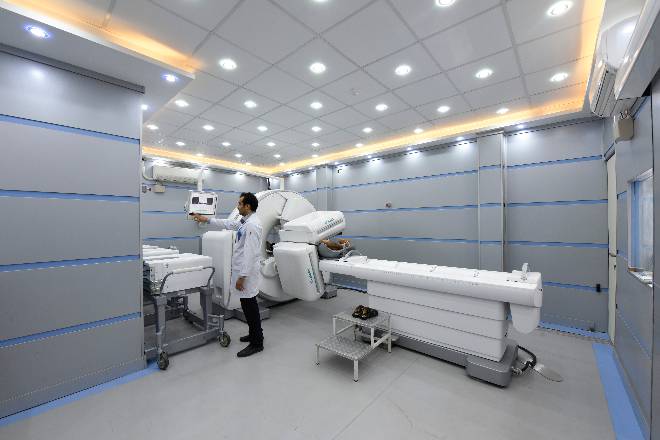
The Nuclear Medicine Department of Jam Hospital began its work on March 21, 1971, as the first private nuclear medicine center in the country, founded by Dr. Sadegh Nezam-Mafi with the goal of providing services and improving health standards. Thanks to the efforts of two professors of nuclear medicine, it was further developed in subsequent years.
Due to the advancements in nuclear diagnostic technology over the past decade, today the most modern hybrid SPECT/CT device in the country, manufactured in the United States, with unique and special capabilities and technology for nuclear imaging of all body organs, has been installed and is operational in the nuclear medicine center of this hospital.
List of Services Provided to Patients in this Department:
Diagnostic Services:
- Cardiac Perfusion Scan (MIBI/Thallium) for assessing ischemia, infarction, and viability
- Rest-only cardiac scan for determining viability and assessing wall motion & wall thickening
- Pyrophosphate (PYP) scan for assessing cardiac amyloidosis
- Whole-body bone scan using MDP radiopharmaceutical
- Parathyroid scan with SPECT-CT capability
- Thyroid scan and thyroid uptake assessment with Technetium
- Lung perfusion and ventilation scan for assessing pulmonary embolism and quantitative preoperative evaluation
- Dynamic kidney scan for assessing obstruction and renal function (DTPA and EC)
- Static kidney scan (DMSA Scan) for assessing renal tissue and renal scars
- Kidney scan with and without Captopril (for evaluating hypertension caused by renal artery stenosis)
- Transplanted kidney scan for assessing ATN, transplanted kidney function, and transplant rejection
- Diuretic renal scan (DRNC Scan) for evaluating vesicoureteral reflux
- Brain perfusion scan for assessing various dementias, brain tumors, and temporal lobe epilepsy using SPECT-CT
- RBC scan for diagnosing hepatic hemangioma and gastrointestinal bleeding
- Liver and biliary tract scan
- Liver and spleen scan
- Gastric emptying scan
- Meckel's diverticulum scan
- Breast lymphoscintigraphy
- Upper and lower extremity lymphoscintigraphy
- Salivary gland scan
- Somatostatin receptor scan (Octreotide) for evaluating neuroendocrine tumors
- Whole-body I-131 scan for evaluating thyroid cancer
- Lacrimal duct scan for assessing lacrimal duct obstruction (Dacryo-scintigraphy)
- Infection detection scan with 99mTc-UBI
- PSMA scan for prostate cancer
- Testicular scan
Therapeutic Services:
- Radioiodine therapy (outpatient treatment of malignant and benign thyroid diseases)
- Therapy with Lutetium-Dotatate (177Lu-Dotatate)
- Therapy with Lutetium-PSMA (177Lu-PSMA)
- Therapy with Samarium, Rhenium, and Lutetium radiopharmaceuticals (Sm153-EDTMP / 188Re-HEDP / 177Lu-EDTMP) for palliative treatment of bone metastases
- Radiosynovectomy for treating inflammatory joint diseases
Introduction of the Device
The Nuclear Medicine Center of Jam Hospital is equipped with a Siemens dual-head SPECT/CT Intevo device. Given that the SPECT/CT method is widely used and well-established in nuclear medicine worldwide today, we decided to make it available to all patients to optimize their diagnosis and treatment process.
As we know, the field of nuclear medicine made tremendous progress in diagnostic quality and anatomical localization with the introduction of SPECT, and this advancement was multiplied by hybridizing images with CT. Today, with precise localization on CT images combined with functional images from nuclear medicine, it is possible to accurately evaluate lesions and their characteristics. Routine advantages of SPECT/CT images include diagnosing and localizing various parathyroid adenomas, detecting bone lesions, and accurately diagnosing pulmonary embolism. The increased precision and accuracy of imaging with this method have been proven in numerous studies.
In many cases, more accurate diagnosis of disease has reduced the need for many other diagnostic evaluations.
Another area for using SPECT/CT is cardiac scanning. In the past, many patients received false positive reports of abnormal cardiac scans and vascular involvement due to soft tissue attenuation in cardiac scan images. Today, with the introduction of SPECT/CT and attenuation correction reconstruction, the rate of false positive reports has decreased.
Treatment
In recent years, with the increasing prevalence of various cancers, many efforts have been made to improve diagnostic and therapeutic methods for better disease control and effective treatments.
Nuclear medicine is a branch of modern medical science that uses radiopharmaceuticals for the diagnosis and treatment of a wide range of benign and malignant diseases.
One of the unique features of nuclear medicine treatments is their targeted and specific nature, which improves treatment effectiveness and reduces potential side effects.
In fact, in nuclear medicine, before performing therapy with radiopharmaceuticals, the suitability of that treatment is assessed by administering small amounts of diagnostic radiopharmaceuticals. This concept is called "theranostics" in targeted cancer therapy, meaning using a molecule labeled with a radioactive element for diagnosis, and if adequate uptake in cancerous lesions is observed, the same molecule labeled with a suitable therapeutic radioactive element can be used for treatment.
Targeted therapies in nuclear medicine began about 80 years ago with radioactive iodine for thyroid diseases. In recent years, with rapid advances in medical science, numerous radiopharmaceutical-based targeted therapies have been introduced and used for various cancers.
For example, in 2018, the radiopharmaceutical Lutetium-DOTATATE (177Lu-Dotatate) received FDA approval for treating advanced and metastatic neuroendocrine tumors. This therapy has increased patient survival and resulted in significant improvement in quality of life.
Also, in early 2022, the radiopharmaceutical Lutetium-PSMA (177Lu-PSMA) received FDA approval for treating metastatic, castration-resistant prostate cancer. This therapy provides good disease control, pain reduction, and improved patient survival.
It is noteworthy that following the positive results of these therapies in European countries, thanks to the efforts of the Atomic Energy Organization of Iran, both Lutetium-DOTATATE and Lutetium-PSMA radiopharmaceuticals have been available to patients in several Iranian medical universities since mid-2016 (late 2016), and the Nuclear Medicine Center of Jam Hospital has been among the first private centers providing theranostic services.
Other common treatments in nuclear medicine include using various radiopharmaceuticals to relieve pain from bone metastases. These treatments can reduce narcotic use and decrease pain for 3-6 months in more than half of patients.
Intra-articular injection of radiopharmaceuticals is an effective treatment for inflammatory arthritis resistant to conventional therapies, for example, in patients with advanced rheumatoid arthritis or joint disorders in hemophilia patients.
In the Nuclear Medicine Department of Jam Hospital, consultations for cancer diagnosis and treatment with radiopharmaceuticals are provided for dear patients, and all radiopharmaceutical-based therapies are performed.
Radiopharmaceutical therapy at Jam Hospital is performed on an outpatient basis (hospital stay usually between 4-8 hours depending on the type of disease and the patient's condition) in the treatment unit with equipped facilities and an experienced staff.